The Dawn After Dashami
Dashami night in the Dooars hills. Three friends, a cottage made of glass, and at 4:53 AM, two tigers. One is in the Forest Department's records. The other isn't.
1. Dashami Afternoon
Ma would have been much happier if I'd stayed in Kolkata for the Pujas. But we went to the Dooars.
"We" means the three of us. Me, Ishaan and Rohan. We studied engineering together at Jadavpur. Now the three of us work at three different offices, but one trip a year together is our rule. This plan was Ishaan's. He always digs up places whose photos make people jealous on Instagram. Rohan is the quiet one; wherever he goes, there's a guitar on his back. And me? I'm the guy who books everyone's tickets and worries on everyone's behalf.
Ma was upset. "You won't be home on Dashami? Who's going to touch my feet for Bijoya?" After the Ashtami anjali, she tied a red thread around my wrist. "It's the Goddess's thread. Don't take it off." I promised I'd call on Dashami night and do my pranam over the phone.
On Navami night we caught the Kanchankanya Express from Sealdah to Alipurduar. Then almost two hours by car. First, tea gardens on both sides, green and flat, as if someone had trimmed them with scissors. Then the forest began, and the road slowly started climbing toward the Buxa hills. The driver pointed. Those tall blue hills over there, he said, that's Bhutan.
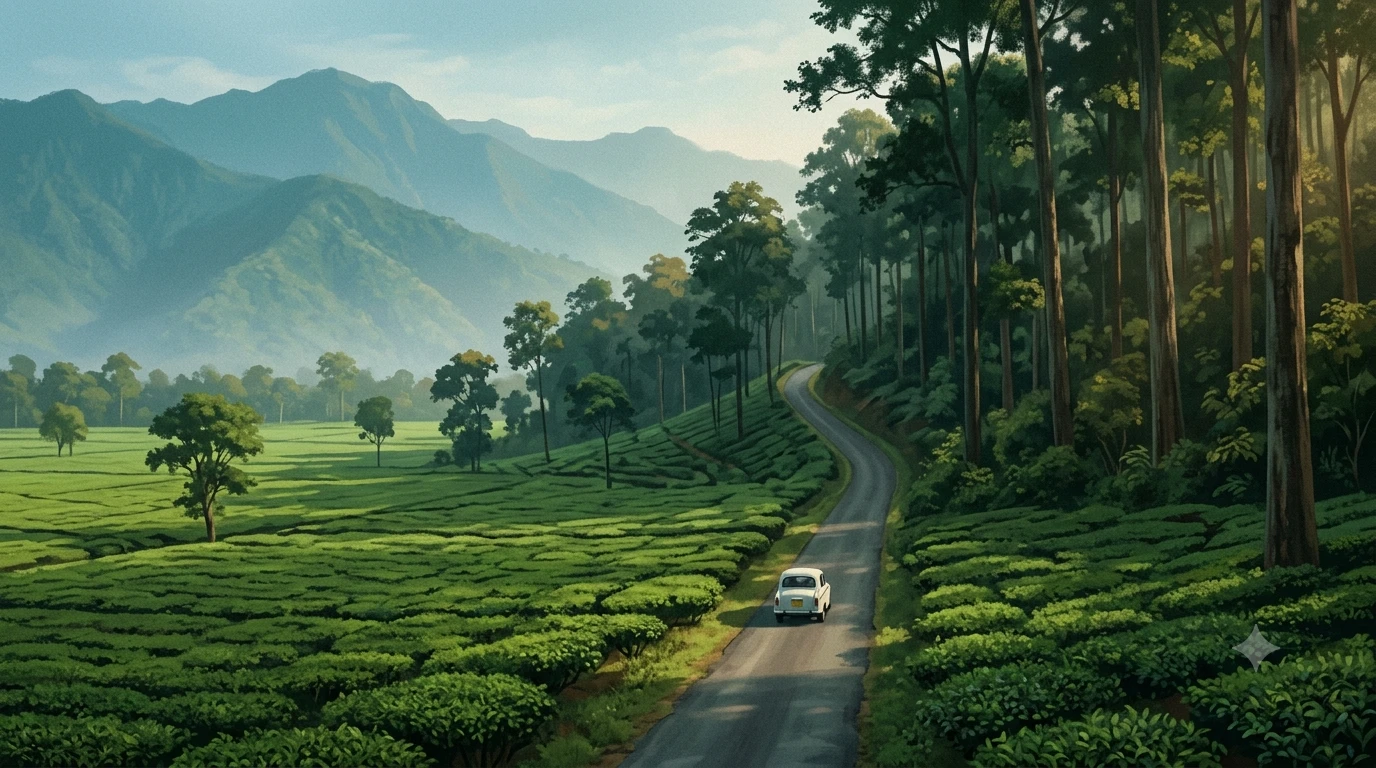
Nilgarh Jungle Retreat sits right beside a tiny hill village. Down by the road is the reception, an old two-storey wooden house with a veranda in front. Around it, a few ordinary cottages. The village is further down, across a mountain stream. And from behind the reception, a gravel path winds up the side of the hill. Almost half a kilometre. At the top of that path, near the shoulder of the hill, stands our cottage. All alone.
The owner, Rudra Roychowdhury, received us on the veranda himself. Khaki jacket, rimless glasses, talked very fast and waved his hands while he talked. He'd grown up in Kolkata and had a big job in Bangalore. After his father died, he'd left everything and come back to turn his grandfather's old hunting lodge into a resort. You only had to hear him talk for a minute to know: this was his dream.
"Look at this," he said, pulling out his phone and opening an app. A map with a few coloured dots. "Built it with the Forest Department. Every tiger in this area has a radio collar. I can sit right here and see where each one is." Ishaan leaned over the screen, then looked up with a huge grin. "Bro, this is literally an office dashboard!"
Where the gravel path starts climbing, there's a huge old shimul tree. At its foot sat a black stone smeared with vermilion, surrounded by marigolds, some dried, some fresh. You see little shrines like this all over the villages. Squatting beside the stone was an old man. Thin, bare-chested, in a white dhoti, hair snow white.
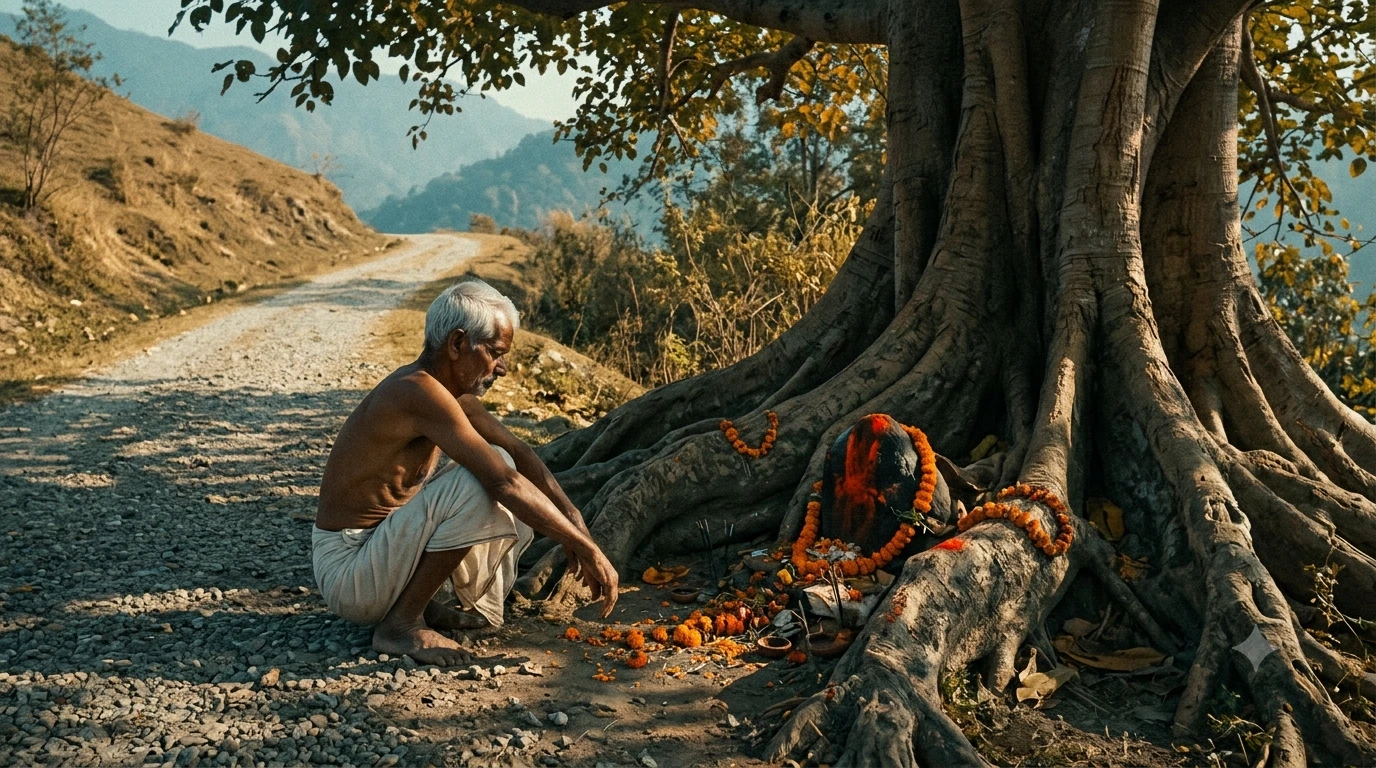
"Bangshi Kaka," Rudrababu said. "Been here since my grandfather's time. That cottage up there is really his household. Cleaning, upkeep, everything. He does it all."
Bangshi Kaka stood up and folded his hands in a namaskar. He didn't say anything. He just looked at each of our faces, one by one.
And just then, a boy came running from somewhere.
Thin, tall, sixteen at most. He was wearing an old India cricket jersey with KOHLI and the number eighteen on the back. And he had such a huge grin that just looking at him lifted your mood. "Dadu, I'll take them!" Before we could say a word, he'd slung two of our heavy bags over his shoulders.
"My grandson, Sunny," said Bangshi Kaka. And for the first time, I saw a small smile on his face.
Half a kilometre of uphill path, and Sunny didn't stop talking once. What's Kolkata like? Does the metro really run under the ground? Had we ever watched a match at Eden Gardens? Had we seen Kohli in person? When he heard we were engineers, he stopped dead. "I'll be an engineer too. I'll study in Kolkata." Then, after a pause, he lowered his voice. "I don't have a ma or baba, so Dadu is everything. One day I'll take Dadu to Kolkata and keep him with me."
When we saw the cottage, all three of us stopped short.
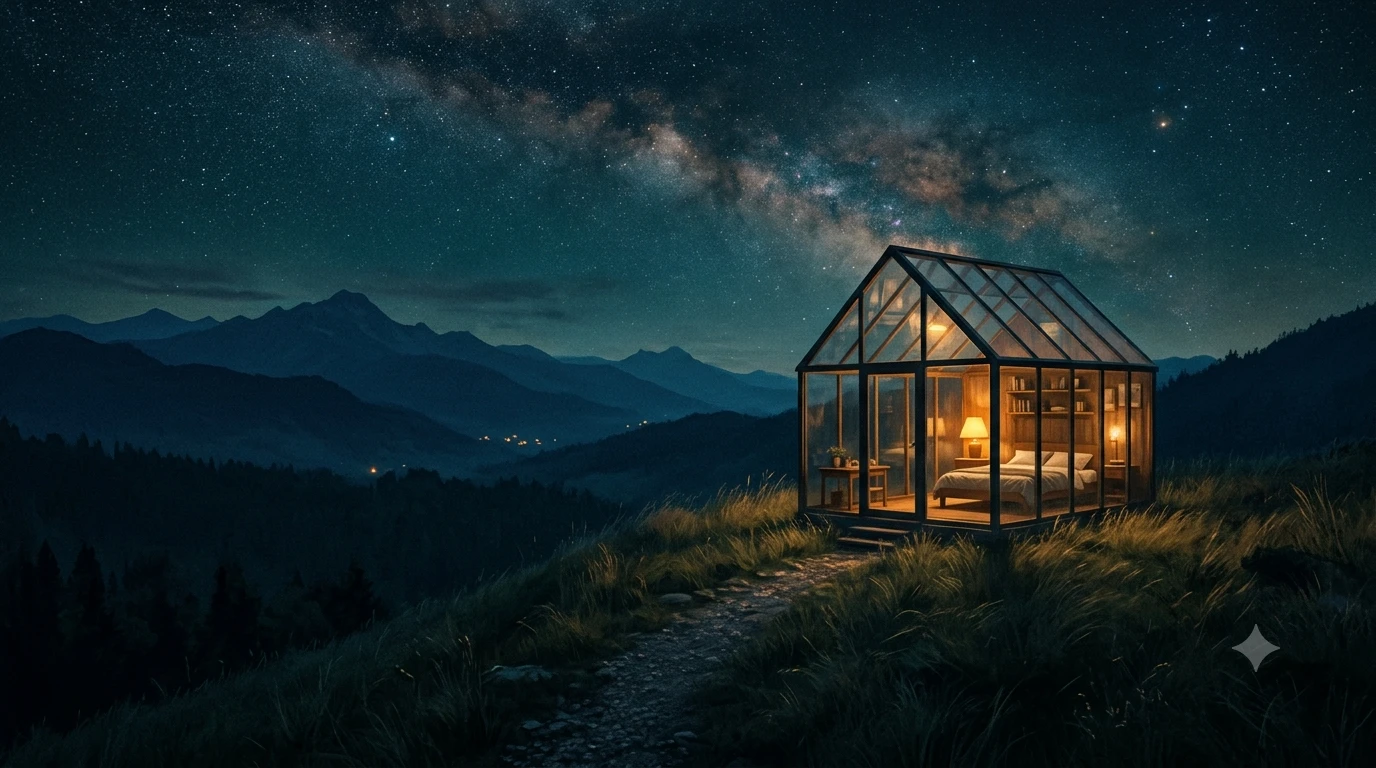
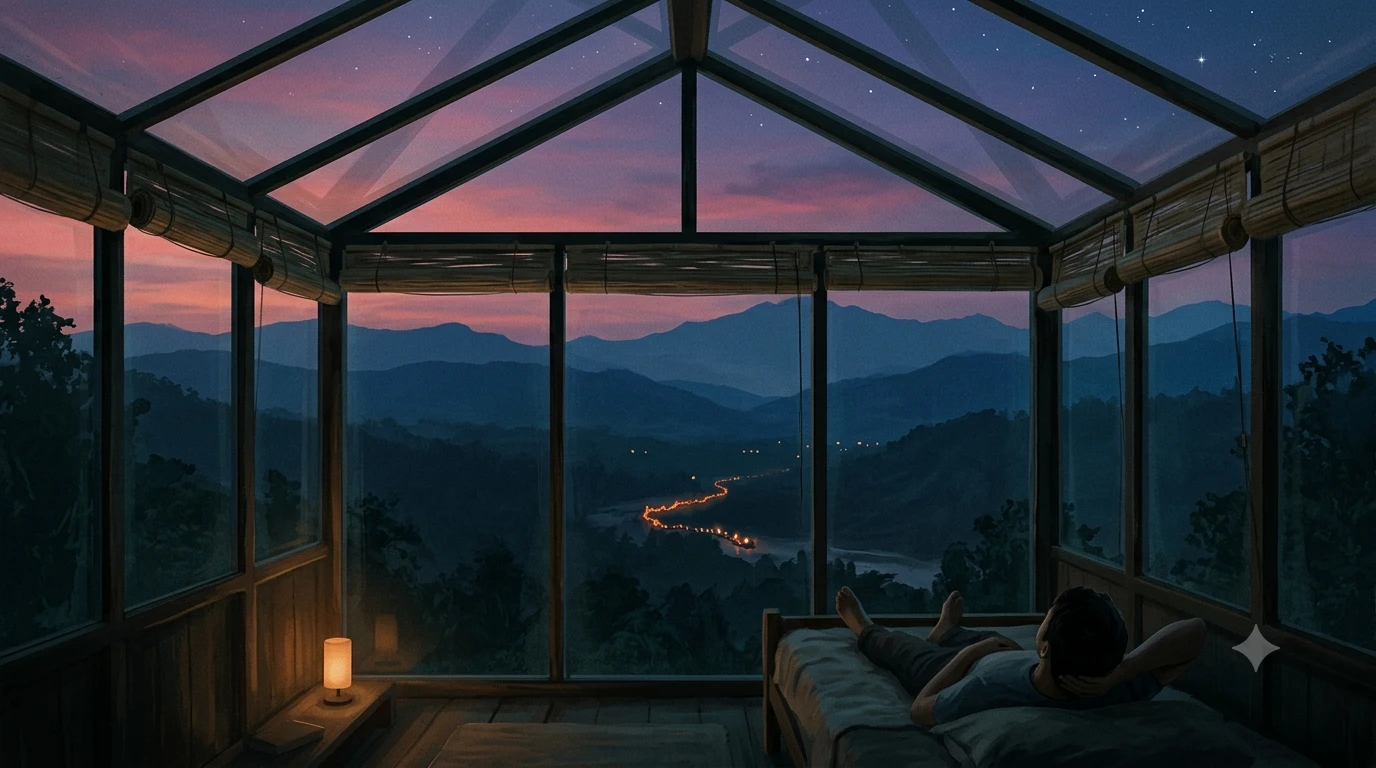
The whole room was glass. The door is in the left wall, facing the gravel path. Right beside the door is a small bed. The back wall is the only real wall, brick and cement, with the bathroom behind it. Against that wall stands a big bed. If you sit on the big bed, everything in front of you is glass, and beyond it the slope falls away toward the dense forest. The front glass has two windows, one on the left and one on the right. The right wall is glass too, and beyond it the hill rises straight up, toward Bhutan. The roof overhead is glass as well.
But right then, you couldn't see a thing through all that glass. Outside, on every side and even over the roof, thick bamboo screens had been let down. The afternoon sun slipped through the gaps and drew thin golden stripes across the floor, the bedsheets, our arms. The room was half-dark, and much cooler than outside.
"This is your glass house?" Rohan said, looking at Ishaan. "It's a bamboo cage."
"Wait till evening, sir. Then you'll see," Sunny said proudly, as if he'd built the cottage himself.
Rohan sat on the bed and took out his guitar. Ishaan kept trying to take photos through the gaps in the bamboo and finally gave up. And I was sitting on the cottage steps when I noticed Sunny hovering nearby, a folded maths notebook in his hand.
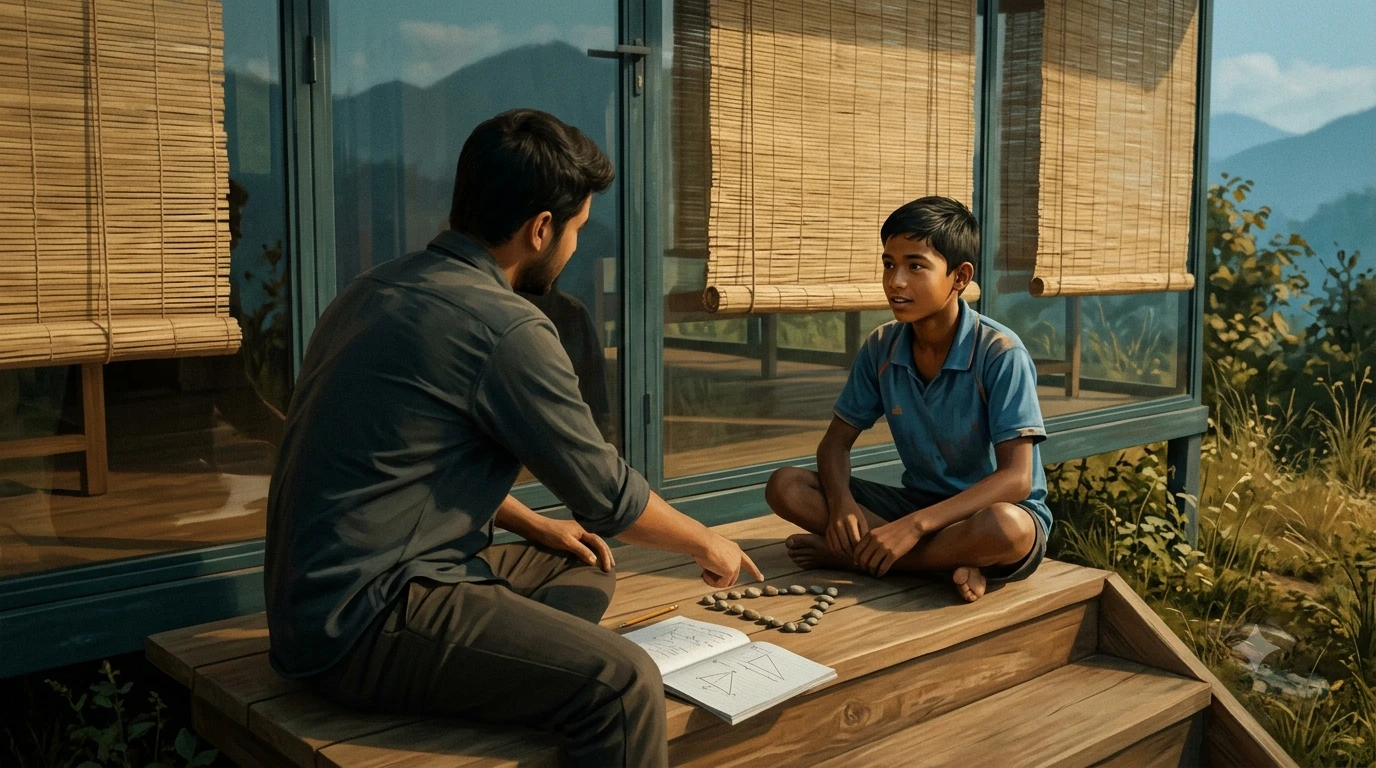
"Dada, can you show me something? Geometry just won't go into my head. Madhyamik is next year."
For the next half hour I sat on those steps, arranging pebbles to explain the theorems about triangles. At first he frowned. Then suddenly, at one point, his eyes lit up. "Oh! That's all it is! It's this easy!" I'll never forget that face.
A little before sunset, Sunny turned up with a bamboo ladder from somewhere. Then he went around the cottage, rolling up the screens one by one. Pull the cord, roll the screen, tie the knot, on to the next. He did it so easily, like he did it every day.
"I do do it every day," he laughed when I asked. "In the evening I roll them up, and in the morning, before the sun gets strong, Dadu comes and lets them down. Otherwise this room turns into an oven by noon, sir."
And with every screen that went up, the room seemed to open up a little more. First the slope in front and the forest below, deep green in the evening light. Then the hill on the right, the last of the sun still caught on its top. Finally Sunny climbed the ladder onto the roof and rolled up the screens overhead, and suddenly the whole sky seemed to come down into the room. Pink turning purple, purple turning blue.
Leaning over the edge of the roof, Sunny shouted, "Now look, sir!"
Ishaan lay flat on his back on the bed, staring up. For the first time ever, I saw him forget to take a photo of a place.
Before he left, I wrote my phone number on the last page of his notebook. "If you ever come to Kolkata, call me straight away. Coaching, a place to stay, whatever you need, I'll sort it out."
Sunny stared at that page for a long time. Then he closed the notebook so carefully, as if there were something precious inside.
Evening fell. From far below, from the village by the river, came the beat of the dhak drums. Dashami. The Goddess was being taken for immersion. In the dark, a line of torches was slowly winding down toward the river. Faintly, from far away, came the chant: "Asche bochhor abar hobe!" She'll come again next year! Then the drums stopped, and everything went so quiet so suddenly that I could hear my own breathing.
Near the window I caught one bar of network. I called Ma and did my Bijoya pranam. Ma said, "Shubho Bijoya. Stay safe, Neelu." I ran my fingers once over the red thread on my wrist.
That night, through the glass roof, I saw more stars than I'd seen in a whole lifetime in Kolkata. Rohan was strumming softly. Ishaan was cursing the network because his photos wouldn't upload.
Before going to sleep, I got up and latched both front windows myself. The door too. Habit. In Kolkata, Ma does this every single night, and I grew up watching her.
Then I switched off the light and lay down.
2. 4:53 AM
Honestly, when I first heard the sound, I thought it was thunder.
Half asleep, I was about to roll over. Then it came again. And this time I knew it wasn't thunder. Thunder doesn't shake the bed. It doesn't make the glass roof rattle. The sound was coming from very close. So close that it rumbled right inside my chest.
I opened my eyes. Still dark. Not completely dark: the sky was slowly turning from black to blue. That moment just before dawn, when the night isn't over yet and the morning hasn't arrived either. Beyond the glass roof the stars were still hanging there, but faded.
Ishaan had sat up beside me. Even in the dark I could tell his face had gone white. On the small bed by the door, Rohan sat with the blanket pulled up to his chin, his eyes wide and round.
"Did you hear that?" Rohan whispered.
Of course I had. I heard it again. Closer.
And I noticed something else. The whole jungle had gone completely silent. Last night the crickets had been deafening. Now not a single one was chirping. Not one night bird. Even the wind seemed to have stopped. It felt like the entire hill was holding its breath. Waiting for something.
I picked up my phone from beside the pillow. No network. Even the one bar I'd caught near the window last night was gone. The screen said 4:53 AM.
"Bro, that's a tiger," Ishaan said. Then he flinched, as if he shouldn't have said it out loud.
"Shut up, what are you saying," Rohan said, but his voice was shaking. "There isn't a single tree around here. Why would a tiger come out into the open like this? It must be far away..."
He didn't finish. Because right then, beyond the glass on the left, just beside the door, a piece of the darkness slowly moved.
3. Beyond the Glass
A tigress. Medium-sized, long-bodied. About five arm-lengths from the door, right where the gravel path began, she stepped onto the grass and slowly sat down. She sat as if she knew the spot well. As if she came and sat right there every day. Between Rohan's bed and her there was only a sheet of glass. That's it. Nothing else.
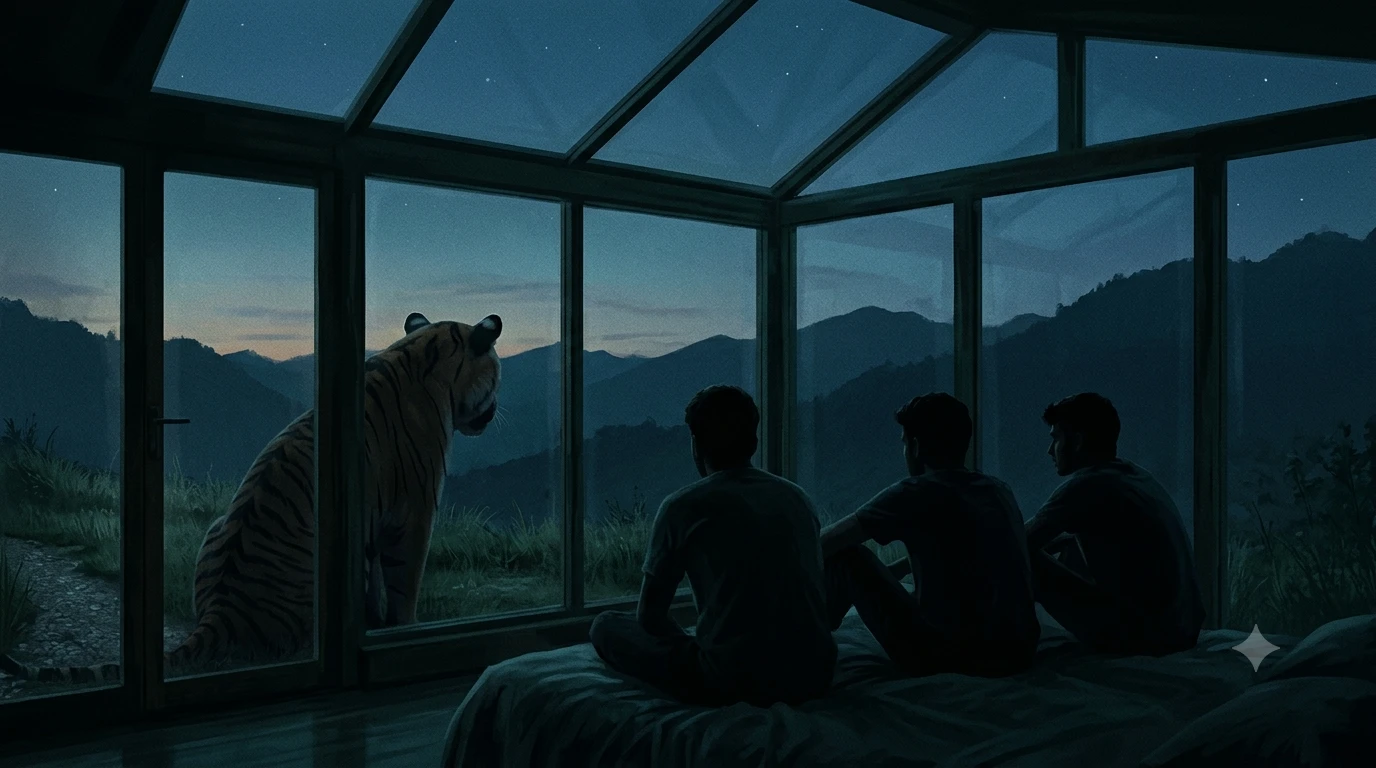
Rohan didn't move at all. All I could hear was his breathing. Short, quick.
Then, from the right, came the second roar.
On the right is the hill. Beyond the glass on that side, the darkness suddenly began to rise. It kept rising and rising, until I had to tip my head back to look. A tiger. But I'd had no idea a tiger could be that big. I'd seen tigers in the zoo, on TV, but this was something else. It had reared up on its hind legs, and its front paws reached the very top of the glass wall, right at the edge of the roof. In the dark I could only make out its shape. And two eyes. Not like fire. Like old gold.
And then it started clawing at the glass.
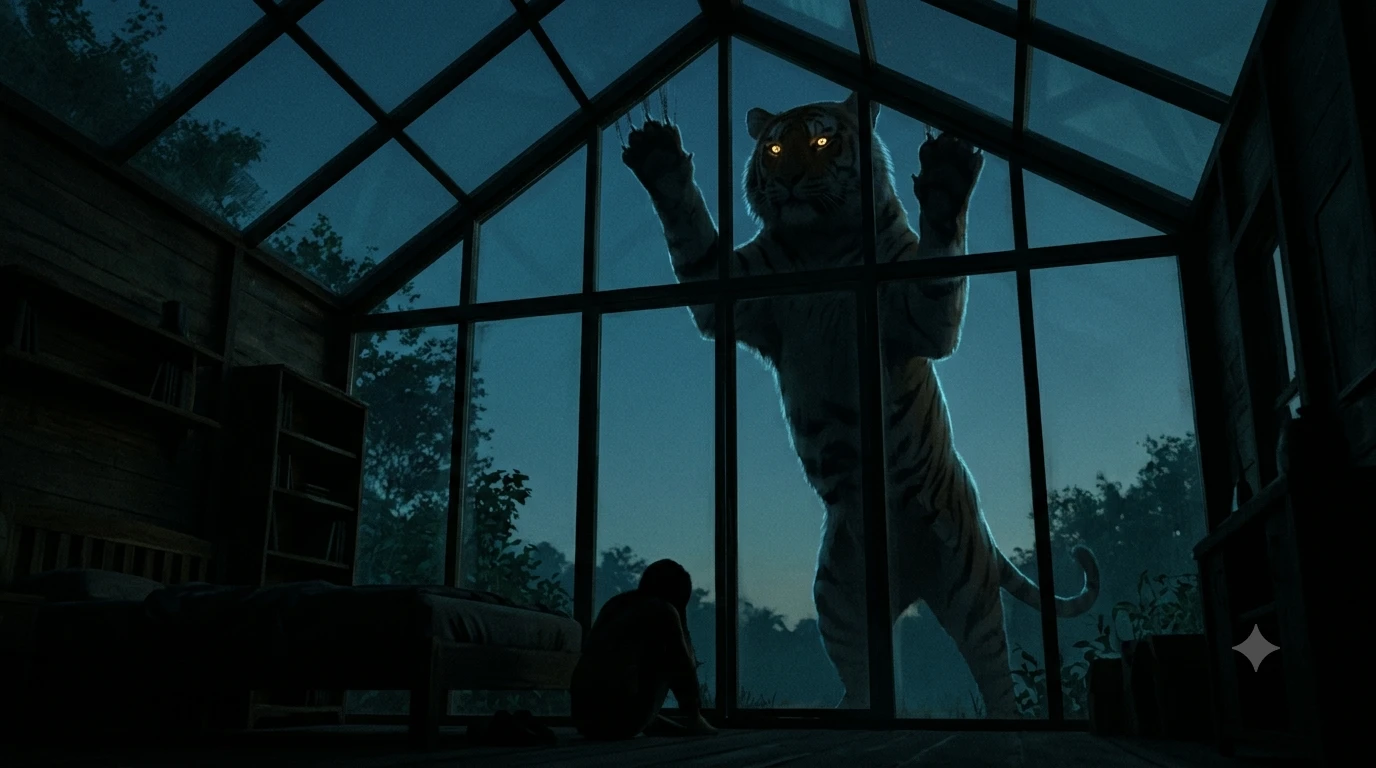
I'll never forget that sound. Claws scraping on glass. Long, thin, going in through your ears and straight into your teeth. Once. Twice. Three times. It felt like it was searching for the weakest spot in the glass.
Ishaan grabbed my hand. His nails dug into my skin; I didn't even feel it. Because right then my eyes fell on the front of the room.
The front right window was open.
Not much, maybe half an inch. But open. Through that gap came the cold dawn air, with the smell of wet grass. And one more smell. Like raw meat. Like iron.
And next to it, the front left window was open too.
For a few seconds my head went completely blank. Last night I had latched both of them with my own hands. My own hands. Click, click. I even remember the sound. So who opened them?
There was no time to think. I jumped off the bed. The floor was ice cold. In three leaps I reached the right window and yanked the pane shut. My hands were shaking so badly that the latch slipped the first time. The second time it caught. Then I ran to the left one. Pane shut. Latch. Click.
And at that exact second, the big tiger threw itself at the glass.
The whole room shuddered. A dull boom rolled across the glass roof from one corner to the other. I thought, this is it, it's breaking. It didn't break. The tiger dropped back down and started a growl from deep in its throat. Steady, never stopping. Not quite an angry sound. More like a surprised one. As if it hadn't got what it was supposed to get.
Then suddenly it turned and vanished into the dark. Downhill, the way the gravel path went.
Where did it go? Why did it go? I didn't know. And not knowing was the scariest part. Because now we couldn't see it anymore. It could come back from any direction.
The tigress, though, didn't leave. She stayed sitting by the door, just as before. Silent.
I don't remember getting back to the bed. I only remember Ishaan picking up the intercom on the side table and pressing the number for reception. On the other end, it rang. Once, twice, ten times. Nobody picked up.
"There's supposed to be a night guard!" Ishaan said, nearly in tears. "Why isn't anyone answering?"
And right then, from very far away, from the path below, a sound floated up. A man's scream. Very short. As if it had started and someone had cut it off halfway.
Then everything was silent again.
The three of us huddled together on the big bed. At some point Rohan had crept over and sat beside us; he didn't have the nerve to stay alone on the bed by the door. None of us said a word. In my head I kept repeating what Thakuma had taught me as a child: let the light come, let the light come, just a little light. I don't know how long passed. Every second felt like an hour.
4. First Light
The light came from behind the hill on the right. First a thin golden line along the top of the hill. Then it slowly crept down, along the glass, and spread across the floor of the room.
And in that first light, I saw the tigress properly for the first time.
She was still sitting beside the door. She hadn't moved a hair. A whole night's dew had collected on her orange fur. Thousands and thousands of tiny drops of water. The first sunlight caught those drops and made them sparkle, and it looked as if a ring of light had formed around her whole body. Like the round glow painted behind a deity's head in the pictures in a prayer room. Exactly like that. Around her neck was a thick black belt with a small box attached. A radio collar. So the Forest Department knew her. One of those coloured dots on Rudrababu's app.
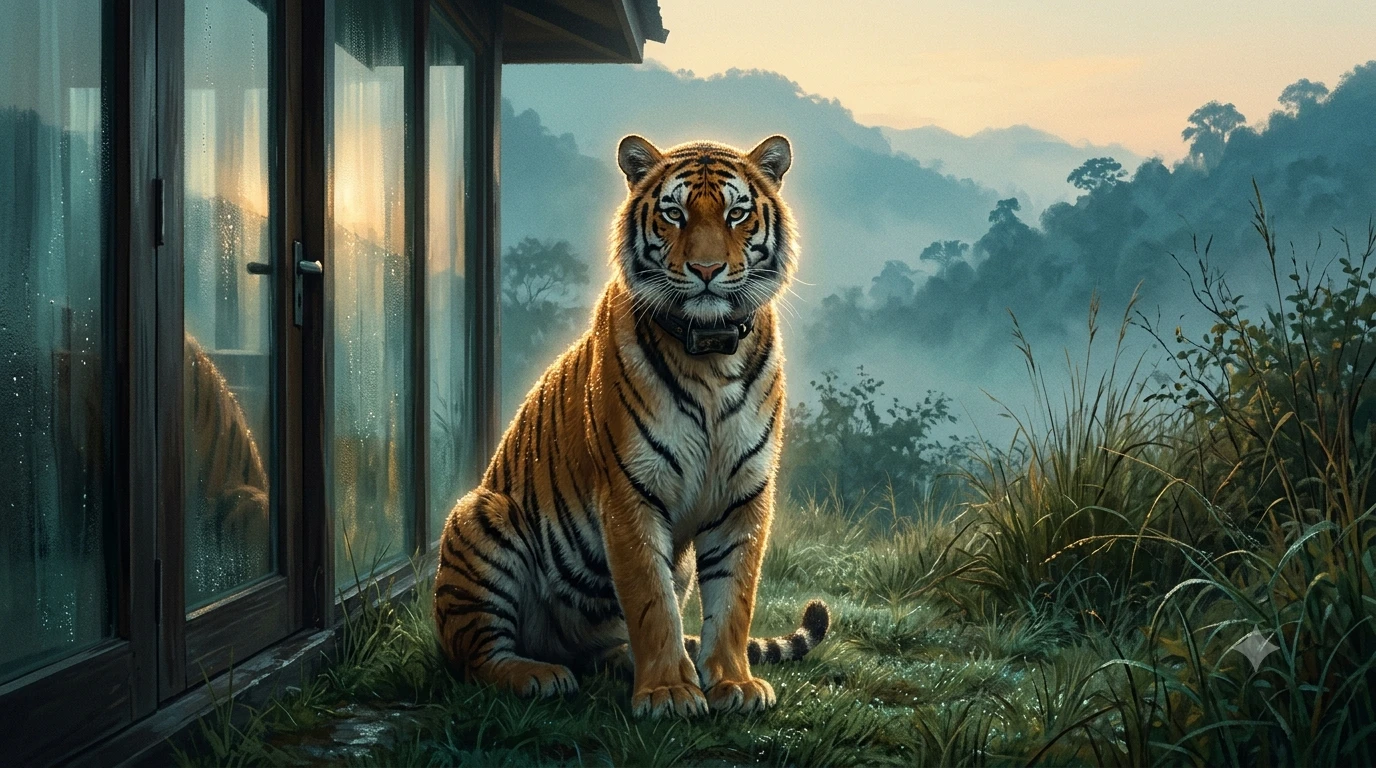
She was looking at us. With very calm eyes. First at Rohan. Then at Ishaan. Then at me. One by one. As if she were counting, making sure all three of us were there.
It felt strange. I was scared, yes, but a different kind of scared. There was no hunger in her eyes. No anger either. There was a kind of sadness. And I felt that she knew us.
Then, on the right, a shadow fell again.
The big tiger had come back.
This time it stood on all fours, about an arm's length from the glass, right in front of me. And this time, in the light, I could see all of it.
Bigger than a buffalo. Its shoulders were so high that even sitting on the bed, I had to tilt my face up to meet its eyes. Its colour wasn't the bright orange of an ordinary tiger, but more like old copper. And the stripes. The stripes weren't straight. They wound along, split apart, joined again. Like the black-ink rivers drawn on old maps. Exactly like that. Its eyes were that old-gold colour. Not blinking once. And right in the middle of its forehead, above the brows, was a long red mark.
At first I thought that was blood too. Because its mouth...
Its whole mouth was smeared with blood. From the chin down to the chest. Not dried blood. Completely fresh. It was dripping off its whiskers onto the grass. When it had left a little while ago, there wasn't a single drop of blood on its mouth. I'd swear to that.
And there was no collar around its neck.
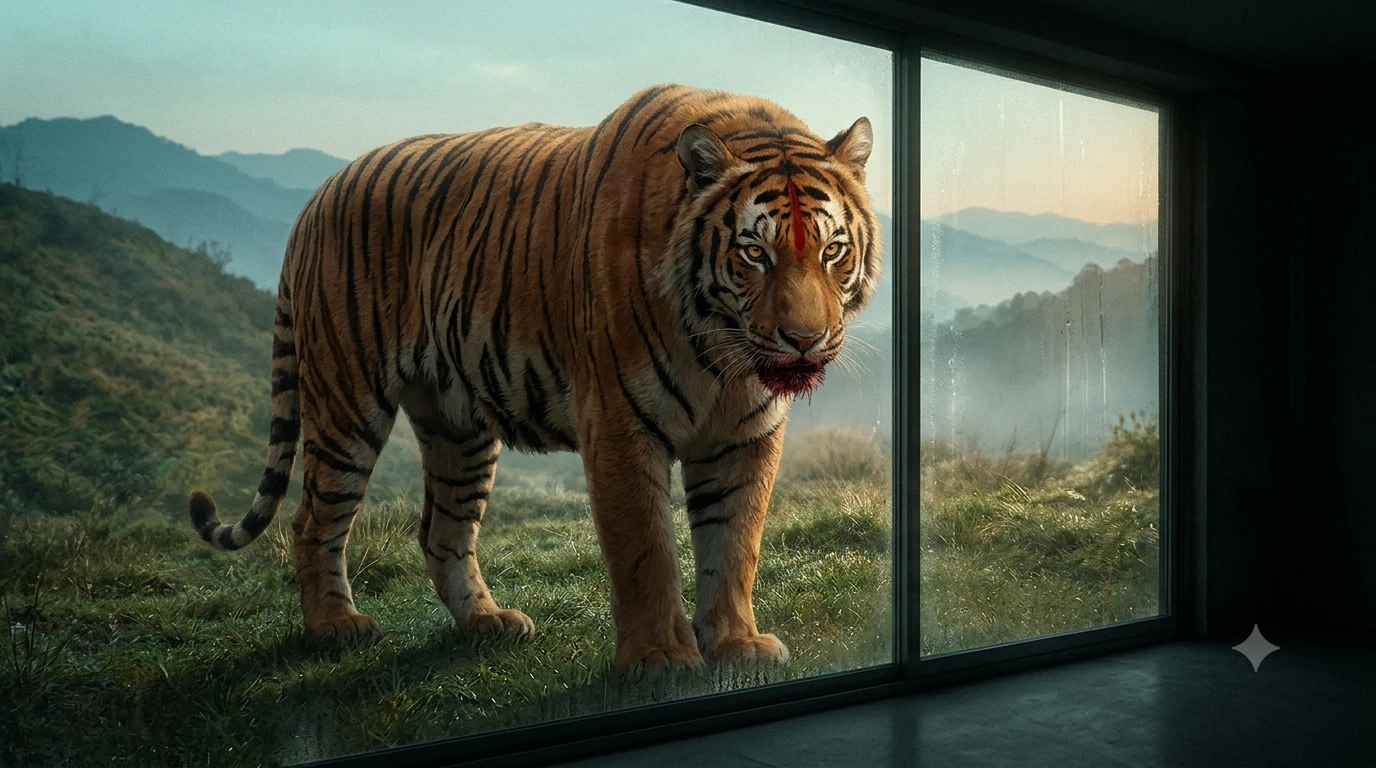
The three of us sat like stone. I don't know if we were even breathing. It felt like this was the end. The last morning on earth.
The tiger kept staring for a long time. Only at me. As if it were showing me something. As if it were saying, look.
Then, for no reason at all, it turned away and slowly started walking down the slope in front, toward the forest below. No hurry at all. As if the job was done. After it had gone a few steps, the tigress stood up. She looked at us once more. Then she quietly followed it.
Until the two orange shapes disappeared into the line of trees below, none of us said a single word.
Then Rohan suddenly burst into loud sobs. And the two of us couldn't hold it in either.
5. Reception
We ran the whole half kilometre of gravel path down. Our slippers kept sliding, and once Rohan even fell, but nobody looked back. It felt like if we looked, we'd see those golden eyes following us.
Only when we got up onto the wooden veranda of the reception did we catch our breath.
Rudrababu was sitting behind the counter, drinking tea. Even seeing us burst in, panting, he didn't put the cup down. He just raised his eyes. And in that look there was no surprise at all. There was a kind of tiredness. As if he'd watched this movie many times, and it had started all over again.
The three of us were talking at once. Tiger, two tigers, glass, claw marks, open windows, nobody answered the phone, the scream. Rudrababu heard it all quietly. Then he took out his phone, opened that app, and turned the screen toward us.
On the map, a line of red dots. Coming down from the hill on the right, passing in front of our cottage, going into the forest below.
"Mohini," he said. "The Forest Department's collared tigress. She comes down this way around dawn, this time of year. Doesn't harm anyone. Only one tiger passed last night. See for yourself."
"Not one, two!" Ishaan nearly shouted. "There was another one, huge, the size of a buffalo! With blood on its mouth!"
Rudrababu shrugged. "It's not on the app."
We asked for our money back. At least another room, one with brick walls. He shook his head. "I understand what you've been through. But there's no rule for refunds. It's not our policy."
He said it as if it were memorised. As if he'd said exactly these words, in exactly this tone, many times before.
What happened next still makes me feel ashamed when I think about it. My voice had cracked. Rohan was crying. Ishaan was pounding the counter. We were practically begging with folded hands. The man who'd been laughing and chatting so much yesterday afternoon didn't move a single line on his face today.
And slowly, people began to gather.
Two cooks came out of the kitchen. A gardener, trowel in hand. A few other tourists, sleepy-eyed, tea cups in their hands. The girl at the reception desk kept typing something on the computer and didn't look up once.
Everyone stood watching. But one thing bothered me. They were watching Rudrababu. Nobody was looking at us. One woman pulled her child behind her. Someone at the back said very softly, "It's started again."
Someone else said, "Has anyone seen the night guard? He was on duty last night. Nobody's seen him since morning."
Through the veranda window you could see the foot of the gravel path. That shimul tree, that black stone smeared with vermilion. And beside the stone, squatting, was Bangshi Kaka. He was placing a handful of fresh marigolds on the stone and muttering something under his breath. Once he raised his face and looked straight at me. Only at me. Then he lowered his eyes.
"Thank God I shut those windows," I said in a broken voice. "Otherwise that big one, with its bloody mouth, would've been inside the room this morning."
Rudrababu's teacup stopped halfway.
He set the cup down on the table very slowly. And for the first time, he looked me straight in the eyes.
"What did you say?" His voice was barely audible. "The windows... you shut them? Yourself?"
I nodded.
"And the big one... had blood on its mouth?"
His face turned the colour of ash. Outside, under the shimul tree, the marigolds fell from Bangshi Kaka's hands to the ground. He staggered to his feet and, as fast as his old body would let him, almost ran up the gravel path.
Rudrababu pulled a torch and an old double-barrelled gun from under the counter.
"Come," he said. "I'm going with you."
6. Back Up the Hill
The path up felt different now. In daylight you could clearly see the tall grass and rocks on both sides, but it felt like something was crouching behind every rock.
Rudrababu walked ahead of everyone. The gun gripped in both hands. Every ten steps he stopped, straining to hear something. The cold, unbothered man from a few minutes ago seemed to have vanished into thin air. Sweat on his forehead, though the morning air was still freezing.
"A minute ago you weren't scared at all," I said. "Why are you scared now?"
For a long time he said nothing. He kept walking, looking straight ahead. Didn't turn toward us once. Then he said, "Because I know Mohini. She has a collar; I always know where she is. But the big one has no collar. No record. In the Forest Department's books, he doesn't even exist. Where he's hiding right now, I don't know."
"But he went down. We saw it with our own eyes."
"This is their seasonal route," he said, as if he hadn't heard me at all. "This time of year, at dawn, they come down from the hill on the right and cross the slope in front of the cottage into the forest below. But along the far edge of the slope, keeping their distance. There are no trees on this side, nowhere to hide. So they don't come near the cottage." He paused, then said very softly, "Usually."
Halfway up there's a bend in the path, from where you can see both the reception below and the cottage above. As we rounded that bend, Rohan stopped dead.
Bangshi Kaka. Kneeling at the edge of the path, and in front of him, lying in the grass, was a torch. Long, black, rubber grip. Still on. In daylight its yellow beam looked pale and helpless. Next to the torch lay a folded piece of paper, limp and soaked with dew.
Beside the torch, the grass was crushed and twisted. A wide trail, as if something heavy had been dragged. The trail went down the slope and disappeared into the line of trees below. Dew on every blade of grass. And mixed in with the dew, red.
On the torch's grip, in big letters of white marker, was written: SUNNY.
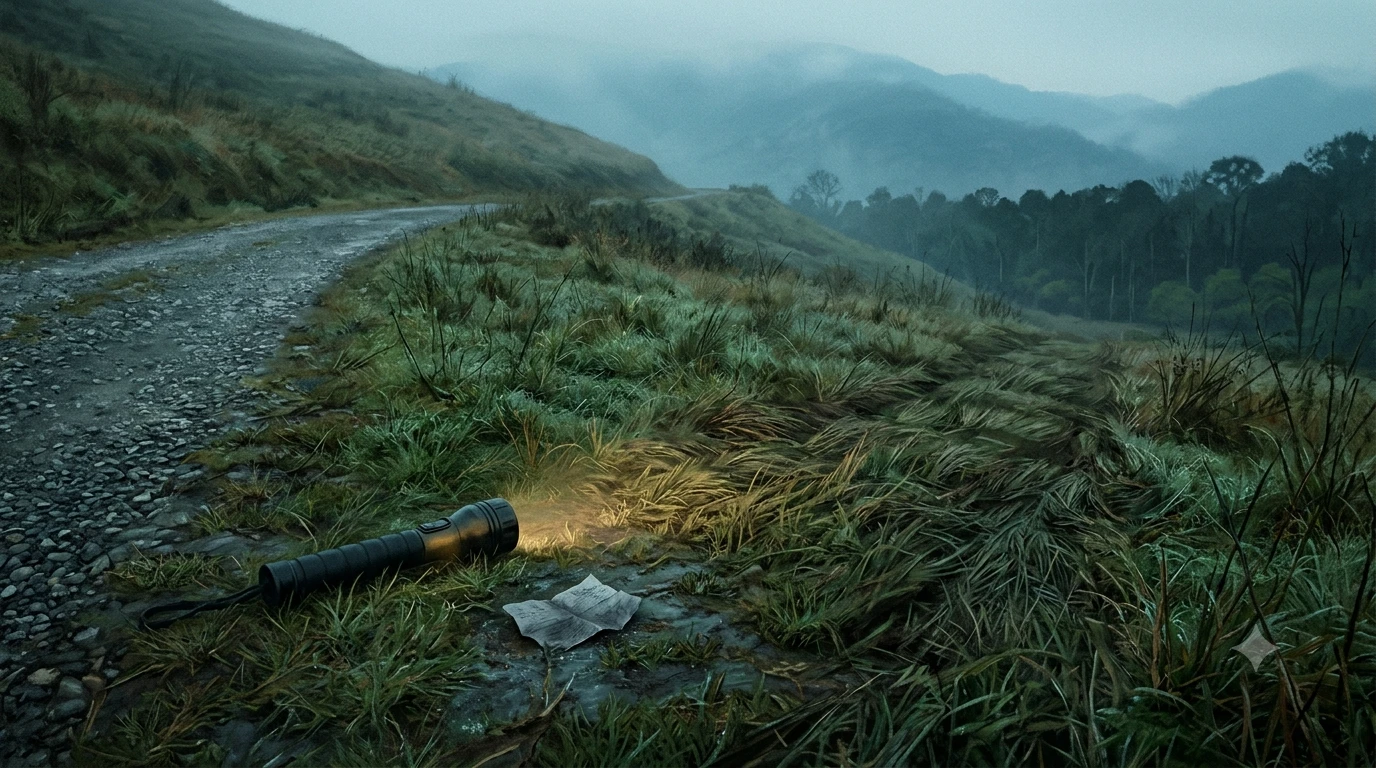
My feet froze to the ground.
"Sunny?" I said. "The boy from yesterday afternoon? But he's... he's just a kid! What was he doing out here at night with the night guard's torch?"
Rudrababu didn't look at me. Didn't say a thing either.
Bangshi Kaka picked up the paper. Very carefully, so the wet folds wouldn't tear. Then he clutched the torch and the paper together to his chest with both hands and began to rock back and forth. He kept saying one thing, over and over, in a whisper: "Sunny re... o Sunny... my Sunny..."
Rudrababu put a hand on his shoulder. "Bangshi Kaka, go home."
He didn't. He got up, holding the torch and the paper to his chest, and silently started walking behind us.
We began climbing again. And that's when I noticed something strange.
All along the path, the grass was covered with dew. Rudrababu's shoe prints showed up perfectly clearly in that dew. One, one, one, ahead of us. Behind us, Bangshi Kaka's bare footprints. But in the middle, where the three of us were walking, there were no prints. The dew was exactly as it had been.
I told myself, we're walking on the stones. That's why there are no prints. That's all. Nothing else.
When we reached the glass house, Rudrababu stopped. And the three of us stopped together.
A padlock hung on the door. Locked from the outside. Old, heavy, brass.
"What's this?" Ishaan said. "We ran out through this very door. Twenty minutes ago. Who locked it?"
Rudrababu didn't answer. He took the bunch of keys from his belt and singled one out. A paper tag was tied to it, gone yellow with age. His hand was shaking so much that it took him three tries to get the key into the lock.
7. Dust
The moment the door opened, a stale, stuffy smell hit us. The smell of a room no air has entered for a long time. Like when you open an old cupboard. Exactly like that.
We went inside. Rudrababu didn't. He stayed standing on the threshold. Bangshi Kaka behind him.
Dust on the floor. Thick dust. So thick you could write your name in it with a finger. Cobwebs in every corner of the glass, with dry leaves and dead insects stuck in them. The big bed was neatly made; the sheet had turned yellow, but not a single fold was disturbed. Same with the small bed. It looked like nobody had slept here last night. Like nobody had slept here for many, many years.
I looked up. Beyond the glass roof, the bamboo screens were still there, but rotted black. Some had snapped their cords and hung in shreds, some had fallen flat onto the glass, with moss growing on them. The screens on the walls were the same; most had fallen and melted into the grass below. The same screens Sunny had rolled up so carefully yesterday evening.
Our bags were gone. Rohan's guitar was gone. Ishaan's charger, which had been plugged in all night, was gone too. The intercom was there on the side table, but its wire was torn. The plastic had melted and gone hard.
"This is a different room," Ishaan said. His voice sounded strange, almost like a laugh. "He's brought us to the wrong room. There must be another one next door..."
But there was no other room. On this shoulder of the hill there was only this one cottage. All three of us knew it.
I walked toward the front windows.
Both windows were shut. Latched. And in the whole room, in all that dust, there were only two places without any. On the two latches. There were fingerprints there. Completely fresh.
My fingerprints.
Behind me I heard Rudrababu make a sound. As if someone had punched him in the chest. Bangshi Kaka gripped the wooden doorframe to steady himself.
Then Rohan made a sound. Not quite a scream; a sound stuck in his throat. He was pointing at the glass wall on the right.
The claw marks were right there. Exactly where the big tiger had stood on two legs and clawed at the glass at dawn. Four long, deep marks, side by side. Running from near the roof almost down to the floor. So deep the glass had gone white inside them.
But the marks were on this side of the glass. On the inside.
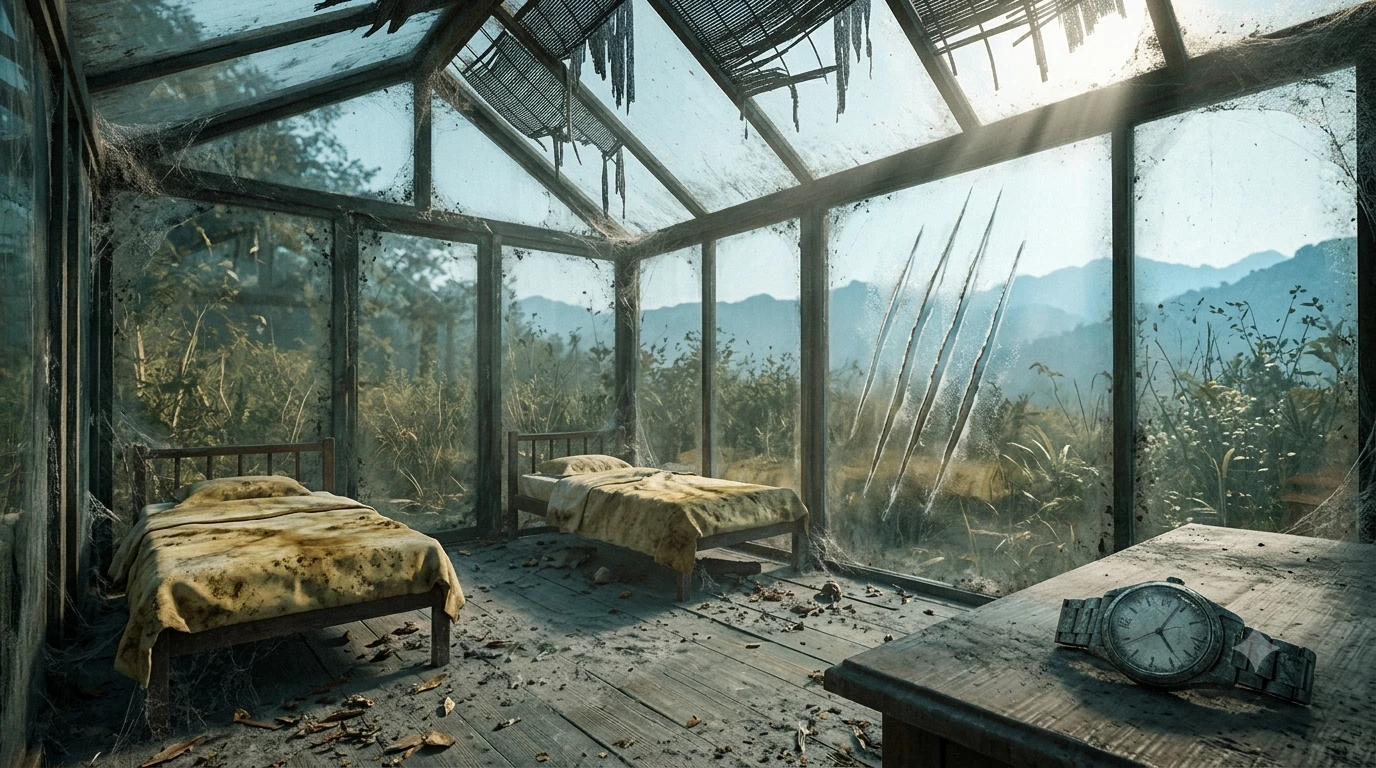
And right below the marks, on the wooden floor, under the dust, was a huge dark stain. Soaked into the wood so deeply it would never come out.
I turned around, and my eyes fell on the side table. Next to the phone, covered in dust, was a wristwatch. Steel strap. The glass cracked like a spider's web. I knew that watch. Baba gave it to me when I got my first job. The first letter of my name is engraved on the back.
The hands had stopped. 4:52.
I looked toward the door. Rudrababu was still standing on the threshold. The morning sun had come up behind him, and his reflection had appeared on the glass wall like in a mirror. Khaki jacket, gun, all clear. Beside him, Bangshi Kaka's reflection too, the torch clutched to his chest.
But beside them, where the reflections of the three of us should have been, the glass was completely empty.
Rudrababu took his wallet out of his jacket's inner pocket. From inside it came a folded piece of newspaper, wrapped in plastic. Very old. The folds were almost tearing apart. You could tell at once he'd been carrying it around for years. He placed it on the threshold. Without setting a single foot inside the room.
I bent down.
Tiger Attack in Dooars' Nilgarh: Three Young Men from Kolkata Killed in Glass Cottage
Date: 12 October 2016. The morning after Vijaya Dashami.
Below, three names. Ishaan Dutta, 25. Rohan Mitra, 26.
And Neel Sen, 26.
My name.
8. Uttar Rai
I don't know how long I stared at that piece of paper. Behind me Ishaan kept saying, "No, no, no, no..." like a broken record. Rohan had sunk down into the dust, his face buried in his hands.
Ten years. We had been dead for ten years. And we hadn't even known.
And suddenly everything fell into place. Why Rudrababu had looked different at the reception. Between yesterday's cheerful, hand-waving man and the man standing here today, there were ten years. Grey in his beard, dark circles under his eyes, lines on his forehead. And Sunny. The sixteen-year-old who'd been learning geometry from me yesterday afternoon was twenty-six now. This resort's night guard. For me it had been yesterday afternoon. For them, ten years ago.
"Why?" I said, looking at Rudrababu. My voice wouldn't come out properly. "Why us?"
Before Rudrababu could say anything, Bangshi Kaka spoke. He was standing outside the threshold, still clutching Sunny's torch and that wet paper to his chest.
"This hill doesn't belong to people, son," he said. His voice was hoarse and low, but every word was clear. "It belongs to Borokorta."
Rudrababu leaned against the wall. His voice was completely different now. Not a businessman's voice. A tired man's voice.
"You know about the Sundarbans?" he said. "There, the moule, the people who go into the forest to collect honey, and the bawali, the woodcutters, offer puja to Bonbibi before they enter the forest. Because the master of that forest is Dakshin Rai. The tiger god. Even today, many of them go into the forest wearing a mask on the back of their heads, so that a tiger coming from behind thinks the man is looking straight at it. And there's a story everyone there knows. Dukhe's story. Dukhe was a poor boy. A honey trader named Dhona took him along into the forest. Then, greedy for a boatload of honey, he left him alone on an island. As an offering to Dakshin Rai. Dukhe cried and called out to Bonbibi, and Bonbibi came and saved him."
"That's a story from the south," Bangshi Kaka said softly. "Our hills have no Bonbibi, son. We have Uttar Rai."
He paused. As if it hurt even to say the name.
"The villagers never say his name. They call him Borokorta. But his name is Uttar Rai. And he isn't like Dakshin Rai."
Then he told the story. Slowly, the way old village men tell it, as if repeating a story he'd heard many times as a child.
Long, long ago, Maa Uma sat in penance in the Himalayas. Mahadev had once teasingly called her dark, and, hurt, Maa had decided she would do penance and become Gauri, the fair one. Day after day, month after month, she sat with her eyes closed. One day a tiger came. Ribs showing from starvation, a fire burning in its belly. In front of it, a woman sitting alone, eyes closed, not moving. Very easy prey.
But the tiger stopped. Looking at Maa's face, it felt that this penance must not be broken. So it sat down. It waited. Day after day. Month after month. Its body dried up like wood from hunger, but still it didn't get up. When Maa finished her penance and opened her eyes, she saw a tiger in front of her, close to death, that had not taken a single step forward.
Pleased, Maa placed her hand on the tiger's forehead. A red mark appeared there, like sindoor. Then she said, "You went hungry waiting for me. From today you are my mount. And people will feed your hunger. But on one condition. You will take nothing by force. Only what people give you of their own free will. Only that is yours."
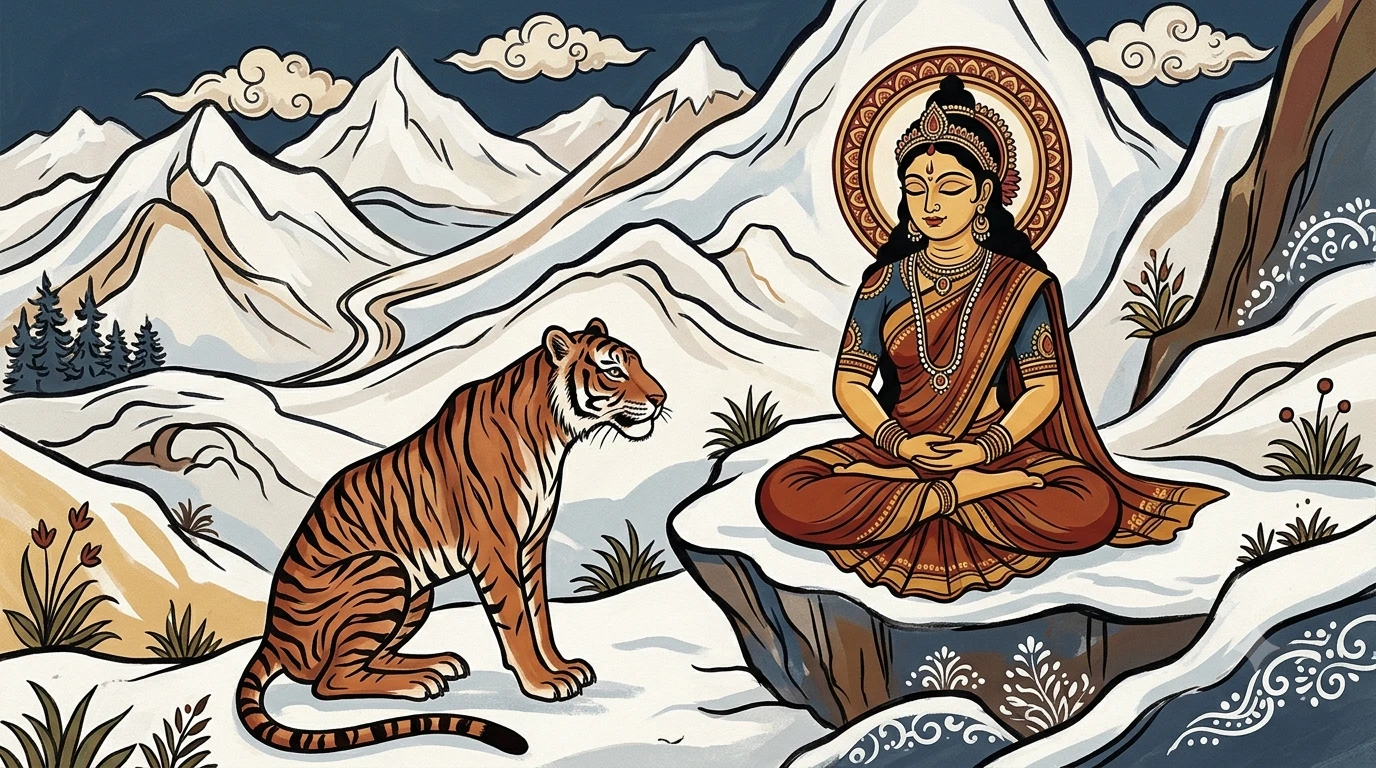
"But Maa Durga rides a lion," Ishaan said. Even in the middle of all this, his old habit of arguing had come back into his voice. "Not a tiger."
A tired smile came over Bangshi Kaka's face. "In your Kolkata pandals it's a lion, son. On the plains Maa comes riding a lion, and that's right. But Maa doesn't belong to just one place. However people know Maa, that's how they worship her."
"He's right," Rudrababu said. "Go north, toward the mountains, and you'll hear people call her Sherawali. Think of those Vaishno Devi calendar pictures: Maa sitting on a tiger's back. And the old stone idol of Maa in this village's temple doesn't have a lion at her feet either. It has a tiger carved there. As a kid, I thought the sculptor had made a mistake."
"It's not a mistake," Bangshi Kaka said. "The lion is Maa's mount for war. Maa rode the lion to kill Mahishasur. The tiger is Maa's mount for patience. The witness to her penance. On the plains Maa comes to slay demons, so it's the lion. In the hills Maa stays in penance, so it's the tiger."
He paused for a moment.
"That tiger is Uttar Rai."
I remembered the long red mark on the big tiger's forehead in the dawn light. I'd thought it was blood.
So every year, during the four days of the Puja, when Maa rides her lion to her father's home, Uttar Rai stays behind in the hills, guarding the gates of the Himalayas. And on Dashami, when Maa returns to Kailash, at dawn the very next day he comes down from the ridge beyond. Down this slope, into the forest below. To collect a year's due. From those who live on his hill.
"Yesterday was Dashami," I whispered. Then I remembered. Not yesterday. Ten years ago. And today too.
"I saw him once," Bangshi Kaka said. "When I was ten. I was hiding with my father behind that stone under the shimul tree. Dawn was breaking, and suddenly all the birds went quiet. The wind stopped. Then he came down. Bigger than a buffalo. His colour was like old copper. His stripes like the rivers on an old map. And on his forehead, Maa's red mark. He passed right by me, so close I felt the heat of his body. He looked at me once. Eyes like gold. Then he went on. My father said he'd looked to see who I was. So that if I ever made an offering, he'd know me."
"In the nineties the Forest Department tried to collar him once," Rudrababu said, very quietly. "With tranquillisers, after a lot of effort. The next morning the collar was found beside that stone under the shimul tree. Still closed. Not a mark on it, not torn anywhere. As if he'd simply slipped out of it. After that, nobody tried again." He gave a dry laugh. "My app shows only one tiger because you can't track a god on GPS."
"And Mohini?" Rohan asked, raising his face. His voice was broken. "Who is she?"
Bangshi Kaka's face softened a little.
Long ago, there was a year of terrible famine in the hills. No rain, no harvest. Forget a buffalo; the village didn't even have a goat to give Uttar Rai at dawn after Dashami. The villagers knew what happened without an offering. He himself touches no one; that's Maa's condition. But his unfed hunger comes down over the whole hill. The streams dry up, the trees die, the children fall sick. In a famine year that could mean only one thing: the village would not survive.
In that village there was a girl. Sixteen years old. Her name was Mohini. On Dashami night, without telling anyone, she climbed the hill alone. At dawn, standing on top of the ridge with her hands folded, she said, "Take me. Spare the village."
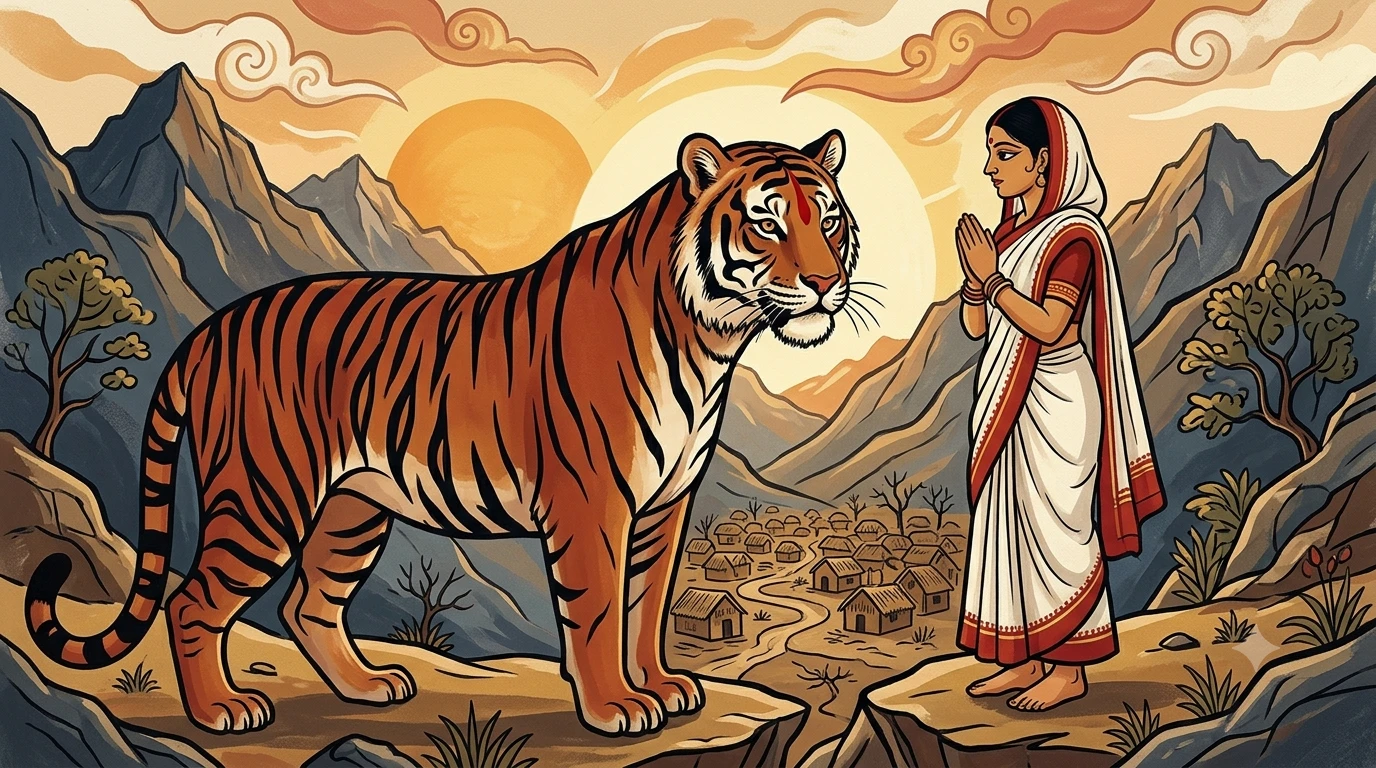
Uttar Rai came and stood in front of her. For a long time. Until then he had only ever been given offerings out of fear. People gave him buffaloes and goats because they were afraid. But no one had ever given themselves out of love. He didn't eat Mohini. He took her to Maa. And Maa blessed Mohini and turned her into a tigress. Since that day, Mohini has walked ahead of Uttar Rai. She sees which offerings have truly been given and which have not. And the ones Uttar Rai takes, she guides their souls over the ridge, to Maa.
"Mohini shows the way," Bangshi Kaka said. "Borokorta takes. The tigress changes with every generation, but the villagers know she is the same one."
"A few years ago, when the Forest Department collared a tigress," Rudrababu said, "a new officer heard the village stories and named her Mohini as a joke. He didn't know he wasn't giving her that name. The name was already there."
I remembered how, at dawn, Mohini had looked at each of us one by one. As if counting. And that sadness in her eyes.
"Then this room?" I said. "This glass room?"
Rudrababu looked around at the glass walls as if seeing them for the first time.
"My grandfather, Harinarayan Roychowdhury, was the zamindar of this area. And a famous hunter. He wanted to build a hunting lodge right here on this shoulder, on Uttar Rai's path. The villagers objected. In the end the village priest stepped in and brokered a pact. The lodge would be built. But in return, every year at dawn after Dashami, the Roychowdhurys would pay Uttar Rai's due on behalf of the whole hill."
The pact was this. On Dashami night, a buffalo would be tied up in this glass room. Sindoor on the stone under the shimul tree, marigolds along the path. And the windows of this room would be left open.
"Open windows mean," Bangshi Kaka said, "whatever is inside is given to him. Closed windows mean it isn't his. Breaking this glass is nothing to him, son. One swipe of his paw and it's dust. But he never breaks a closed window. Maa's condition. He will take nothing by force."
I looked at the claw marks on the glass to the right. This morning he had clawed at the glass. He had thrown himself at it. But he hadn't broken it. Now I understood why.
"My grandfather built this room out of glass for only one reason," Rudrababu said. "So that he could see from outside what had been placed inside. This was never a bedroom. This is the offering room. I brought in those two beds. I put up the bamboo screens outside too, so the room wouldn't cook in the daytime sun. In my grandfather's time there was only one thing in this room. A post to tie the buffalo to." He paused and looked at the big bed. "The hole for that post is still there. Right under that bed."
For sixty years the rule was kept. First Bangshi Kaka's father did it, then Bangshi Kaka himself. A buffalo every year. And in sixty years, not one person on this hill was killed by a tiger. No villager, no tourist.
Then Rudrababu came back. A man raised in Kolkata, educated. He turned the old lodge into a resort. Built the app with the Forest Department. And to him, the buffalo sacrifice, the sindoor, the open windows were all just village superstition, and a cruel ritual of killing a helpless animal every year. In 2016 he stopped it. He turned the offering room into the resort's most expensive cottage. He brought in two beds and put up bamboo screens outside. Screens down in the daytime, rolled up at dusk, and guests lying under a glass roof watching the stars. You couldn't ask for a better thing to sell.
"Bangshi Kaka fell at my feet," Rudrababu said. His voice was breaking. "He said, babu, without the offering his hunger will come down on the hill. The village won't survive. I laughed. I said, Kaka, it's 2016. The tigers have GPS around their necks."
He paused.
"That year, in the Puja season, the first booking for this cottage came from three boys from Kolkata. For Dashami night."
I looked at the window latches. I remember it clearly: that night I latched them with my own hands before going to sleep. The way Ma does. Click, click.
So who opened them?
Outside the threshold, Sunny's torch was trembling in Bangshi Kaka's hands.
9. Sunny
"I knew," Bangshi Kaka said. Very softly. "I've known for ten years. I never told anyone."
Rudrababu turned and looked at him. As if he hadn't heard properly.
Bangshi Kaka sat down beside the threshold. He laid the torch in his lap. And he told us about Sunny. From the beginning.
When Sunny was five, a landslide one monsoon took both his parents. From then on, Bangshi Kaka was everything to him. Mother, father, grandfather, friend. At night, when the power went out, Bangshi Kaka would light a hurricane lamp and tell him stories. And he told him the stories the old men of the hills know. Uttar Rai's story. Mohini's story. The story of what happens to the hill when there's no offering.
"I'm the one who put that fear in his head, son," Bangshi Kaka said. "Me."
In 2016, when Rudrababu stopped the ritual, Sunny was terrified. He'd wake up crying at night. He'd say, "Dadu, the streams will dry up now. There'll be sickness in the village. You'll die." Bangshi Kaka would scold him and tell him to hush, nothing would happen. But he knew, himself, that something would.
On Dashami afternoon, Sunny carried our bags up. Learned geometry from me. Took my phone number on the last page of his notebook. And that same night, he stole the spare key to the cottage from his grandfather's waist.
At three in the morning, he came up the gravel path barefoot. He unlocked the door and slipped inside. The three of us were fast asleep. Quietly, he lowered the latches on the two front windows and opened the panes just a crack. Then he went out and locked the door from the outside. So that even if we woke up, we couldn't get out.
4:52 AM.
Nobody said a word. There was only the sound of Rohan crying. Ishaan stood with his forehead against the wall, eyes shut.
I can't really explain what was going on inside me. Anger? Yes, anger. But along with it, a face kept floating in front of my eyes. Two eyes suddenly lighting up over a row of pebbles. "Oh! That's all it is! It's this easy!" The boy who said that was the same boy who came a few hours later and opened the window right by my head.
"He was a frightened sixteen-year-old child, son," Bangshi Kaka said. "He thought three strangers in exchange for a whole village. In exchange for his grandfather." He paused. "But you weren't strangers. And that's what ate him alive for ten years."
The next morning, as soon as the news spread, Sunny came home and collapsed at his grandfather's feet. In his hand was that maths notebook, open to the last page. He told him everything. And Bangshi Kaka said nothing. He didn't tell the police, didn't tell Rudrababu. He was his grandson. And once an offering has been given, it can't be taken back.
"But Uttar Rai never makes a mistake in his accounts," Bangshi Kaka said. "Remember Dukhe's story? The life Dhona offered wasn't his to give. The hills have the same law, son. When someone offers another person's life as if it were their own, that offering is stolen. Mohini can't take those souls to Maa. They stay trapped. And the debt stays on the head of the one who gave it. Some day, one way or another, it gets paid."
Trapped. I thought about the sadness in Mohini's eyes. Every year she came and sat by that door, counted us, and knew she couldn't take us with her.
And after that, Sunny never stopped.
Rudrababu never allowed the buffalo sacrifice again. So every year, on Dashami night, Sunny would sneak up the hill. He'd unlock the padlock. He'd open the windows of the empty glass house. An empty room, where no one slept anymore.
But the room wasn't empty.
Every year, at dawn after Dashami, the three of us came back. We woke up, saw the tigers, saw the open windows. And every year Uttar Rai, by the terms of the pact, came in through those open windows and took us. Again. We never remembered a thing. Only the claw marks on the inside of the glass grew a little deeper every year.
And the hill lived. In ten years, the streams didn't dry up once. Not one child died of sickness. The whole village slept peacefully, and never even knew at whose cost.
Sunny never sat for his Madhyamik. He never went to Kolkata. As soon as he turned eighteen he took the night guard job at this resort, so he could stay close to the cottage. So that nobody would ever find out. Every year, after opening the windows, he'd sit at that bend halfway down the path. Until dawn. And cry.
Bangshi Kaka lifted the wet paper from his lap. He unfolded it very carefully. Then he reached out and laid it on the threshold, facing me.
A page torn from a maths notebook. Yellowed, the folds almost worn through. The ink had run a little in the dew, but you could still read it. My handwriting.
If you ever come to Kolkata, call me. Neel-da. And below that, my phone number.
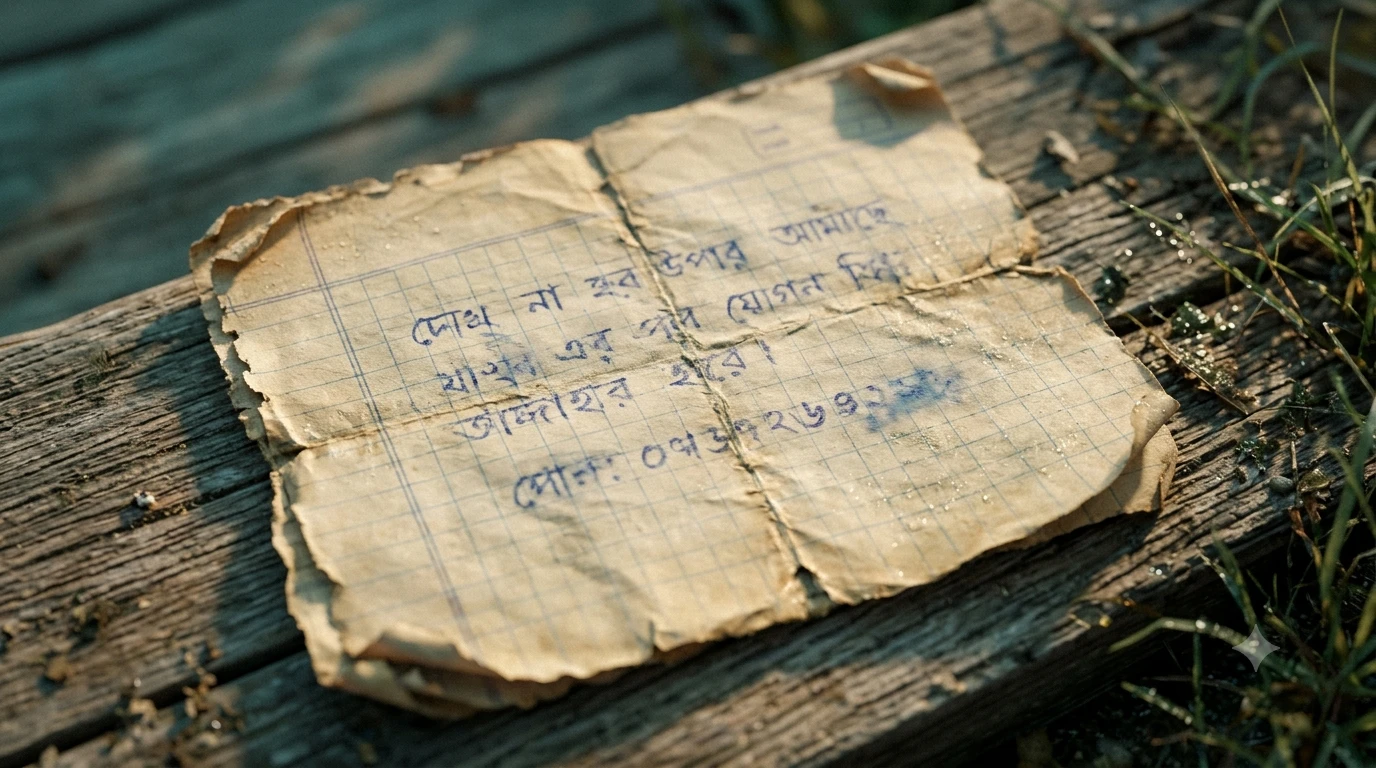
"He carried this in his shirt pocket for ten years," Bangshi Kaka said. "Never called once. How could he?"
I kept staring at the page. And for the first time that whole morning, tears came to my eyes. Not from anger. From something else.
Rudrababu knew none of this. All he knew was that every year, at dawn after Dashami, the phone at reception rang. From this room's line, which had been dead for ten years. Then three boys came running down to the reception, talking about two tigers, asking for a refund. Every year he said exactly the same words he'd said in fear that first year. Because he didn't know what would happen if he said anything else. The staff had been told: on this one day, don't look toward the reception. By noon we faded away. He locked the room again. And with that newspaper cutting in his wallet, he lived through another year.
"Refund," Rudrababu said. A broken, bitter laugh. "What can I give back to the dead? Every year you ask for it, and every year I say no. Because I have nothing to give. In ten years I haven't been able to look your parents in the eye even once."
"But today," Bangshi Kaka said, looking at me, and for the first time I saw something else in his eyes. Not fear. Something else. "Today you shut the windows, son. For the first time in ten years."
"I remembered," I said. "That I'd latched them."
"Yes. And that's what matters. An offering is only an offering when it's given. By shutting the windows with your own hands, you told him you were nobody's to give away. You said no." He clutched the torch tighter to his chest. "And when a stolen offering is refused, Uttar Rai goes to the one who gave it. To collect the debt."
Everything fell into place. The big tiger had growled in surprise at the shut windows. Then it had turned and gone down the gravel path. To that bend halfway down, where Sunny was sitting, like every year. That short scream. The phone ringing at reception with no one there to answer it. And then the tiger had come back and stood beyond the glass, with its bloody mouth, staring only at me.
It had come to show me the debt was paid. By the right person.
"This is justice, son," Bangshi Kaka said. "I know it. For ten years I knew this day would come." His voice broke, and the old man who hadn't made a single sound while crying until now pressed the torch to his chest and began to sob. "But he was still my Sunny."
Rudrababu sank down onto the threshold. He set the gun down beside him and buried his face in his hands. "If I'd only listened to Kaka that day..."
10. Bijoya
I picked up the notebook page from the threshold.
This morning I'd been able to lift the window latches, so I knew I could touch things if I wanted to. The page was light, damp, soft. I folded it again, the way it had been. Then I went and sat beside Bangshi Kaka, took his hand, placed the page in his palm, and closed his fingers over it.
Bangshi Kaka started. He couldn't see me, I know that. But he felt something in his hand. He kept staring at his own fist in wonder.
"He was a kid," Ishaan said quietly, behind me. "A scared kid."
Rohan didn't say anything. He just nodded.
And right then, I felt it. The cold was gone.
All morning a strange cold had been sitting inside my bones. Ever since I woke up. Maybe for ten years. It wasn't there anymore. By now the sun had climbed over the top of the hill, and it was coming in through the glass and falling on me. And for the first time, I could feel it. Warm. Comfortable. Just like standing on a Kolkata rooftop on a winter morning.
Rohan raised his face. His tears had dried. Ishaan put a hand on my shoulder. His hand wasn't cold anymore.
Rudrababu stood up. Wiped his eyes. Then he looked into the room, at a spot where none of us were standing, and said:
"I don't know if you're still here. But listen. Today I'm going to Kolkata. I'll go to all three of your homes. I'll tell them everything. Everything that happened. Everything I couldn't say for ten years." He paused and looked at Bangshi Kaka. "And nobody will ever rent this room again. From next year, the ritual will happen again. Exactly the way Kaka says."
Bangshi Kaka didn't say anything. He just folded his hands and touched them to his forehead.
Outside the door, at the head of the gravel path, Mohini was sitting.
In exactly the spot where she'd sat at dawn. None of us had seen her come back. She was looking at us. With the same calm eyes as at dawn. But this time, the sadness was gone from them. This time she wasn't counting. She was waiting.
Rudrababu looked toward the door. His eyes passed right over Mohini, as if there were nothing there but grass and sunlight. He couldn't see her. We understood: now only the three of us could.
But Bangshi Kaka sensed something. What, I don't know. Maybe a man who has carried this hill's stories in his heart all his life can feel these things. He slowly turned toward the door, looked at that exact spot at the head of the path, and bowed until his forehead touched the ground. He whispered, "Maa Mohini. Take them."
Mohini stood up. She looked back once. Then she slowly began to walk. Not down toward the forest. To the right, toward the hill. Toward the top of the ridge, beyond which lay Bhutan, and beyond that the snow mountains, and far, far beyond those, Kailash. Dashami had passed yesterday. Maa had gone back that way yesterday.
Mohini shows the way.
The three of us looked at each other once. Then we walked out through the dust. Past Rudrababu, past Bangshi Kaka. We stepped onto the dew-wet grass. I didn't look back, but I know we left no footprints. And this time it didn't scare me at all.
We'd gone a few steps when a sound came from below. Slow footsteps on the gravel.
A woman was coming up the gravel path. Slowly, stopping now and then, out of breath. She was wearing a white saree with a red border. In her hands, a small brass lamp and a garland of marigolds. Her hair was snow white.
I stopped.
Ten years ago, Ma didn't have a single grey hair. I used to tease her: "You look like my elder sister." Now she'd grown much thinner. Her shoulders stooped a little. But the way she walked was the same. The way she held the lamp in both hands was the same too.
I could tell at once this wasn't the first time Ma had walked this path. Her feet picked their way over the stones like someone who knew the road. For ten years, every year on the morning after Dashami, Ma must have come here. To light a lamp at the door of the glass house, to leave a garland. And every year Rudrababu must have watched from a distance, unable to go near. Now I understood whose eyes he hadn't been able to meet for ten years.
"Ma," I said.
And at that exact moment, Ma stopped. In the middle of the path. As if someone had called her name from behind.
I ran down. I stood in front of her. Ma was looking toward me, but not at me. Past me, toward the hill. I bent down and touched her feet. Ten years ago, on Dashami night, I'd done my pranam over the phone and promised I'd do it properly in person when I got back. Today I did.
Ma trembled. She looked down at her feet. The lamp's flame flickered, though there was no wind. Then, very softly, almost like a breath, Ma said, "Neelu?"
I kept looking at Ma's face. And I saw a smile coming over it. Slowly, as if she were remembering something she hadn't used in a very long time. For the first time in ten years. I know, because I know my mother's face.
"Shubho Bijoya, Neelu," Ma said.
Exactly the words Ma had said the last time. Ten years ago, on the phone.
The red thread on my wrist was glinting in the sun. I touched Ma's hand once. Then I stood up.
Rudrababu was coming down from above. He came and stood in front of Ma. And for the first time, for the first time in ten years, he looked her straight in the eye.
"Mashima," he said. "There's something I need to tell you."
I didn't stay any longer. Ishaan and Rohan were waiting up above. Mohini too. I climbed up to them, and the four of us started up the slope. Toward the ridge. Toward the sun.
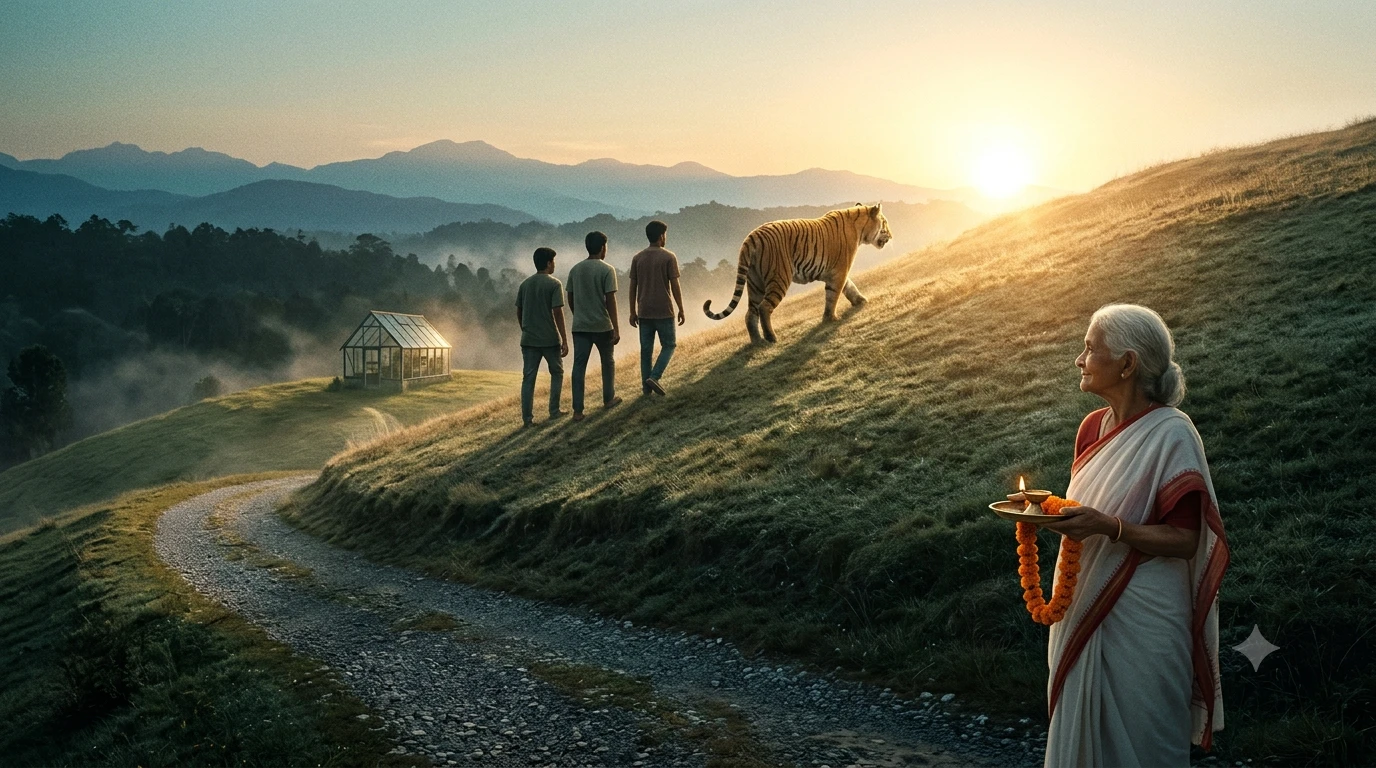
After we'd climbed a bit, Ishaan suddenly said, "Well, at least Mashima will finally know the truth. That's our refund, I guess."
"And the money?" Rohan said.
Ishaan thought for a second. "The guy never did give that back."
Rohan burst out laughing. For the first time in ten years. Then so did I.
Down below, from the village across the river, someone blew a conch shell. A long, clear sound that struck the hills one after another and came echoing back.
Laughing, we followed Mohini up toward the top of the ridge. Through the sunlight. And this time, for the first time in ten years, the dawn truly ended.
Leave a comment
No account needed. Leave the name blank and you'll get a random one.